SGSAH Collaborative Doctoral Award Studentship

PhD Title: “Mainlining AI into the Veins”? Library collections as data in the age of Extractive AI Capitalism

Funding body: AHRC 

Deadline for applications: 5pm, Friday 30th May 2025

Interviews date: 12th June 2025

Start date of the PhD: 1 October 2025

Duration: Three years six months (Full Time) / Seven years (Part Time).

The University of Glasgow, University of Edinburgh, and the National Library of Scotland are pleased to announce a fully-funded PhD studentship, under the AHRC Collaborative Doctoral Award scheme with the Scottish Graduate School for Arts and Humanities (SGSAH). The successful candidate will work with the University of Glasgow and the National Library of Scotland. The supervisors will be Prof. Paul Gooding (University of Glasgow), Prof. Melissa Terras (University of Edinburgh), Dr. Sarah Ames and Dr. Patrick Hart (National Library of Scotland).

This is a fantastic opportunity to work with leading practitioners and researchers in the Library and Information sector, and we expect it to appeal to suitably qualified candidates with a postgraduate degree in a relevant discipline. The successful student will benefit from the unique opportunity to  explore their own research interests, while directly informing digital research activities at the National Library of Scotland. Students will be encouraged to develop their own approach to the topic, which may include questions around the decolonisation of library search, gender bias in the use of scholarly resources, and the development of methodological and critical frameworks for future research into library discovery systems.

The studentship will commence on 1st October 2025, and the successful student will be based in Information Studies at the University of Glasgow. They will also benefit from training, support, and networking via the Edinburgh Centre for Data, Culture and Society, and the National Library of Scotland. The studentship will include a placement at the NLS, to be determined in collaboration with the student. The award will include a number of training opportunities offered via SGSAH, and  an additional £500 p/a mobility allowance.

The Research Project

Since 2023, there has been an explosion in AI-generated content produced by Generative AI and Large Language Models. Many GenAI companies have been criticised for extractive AI practices grounded in late-stage capitalism, incentivising decisions that maximise shareholder profits without considering human agency and autonomy, extracting data (Eve, 2024) and natural resources (Lehuedé, 2024). At the same time, libraries have sought to make their collections openly available as datasets (Padilla et al., 2018), building on assumptions that open data principles are a fundamental good. However, given the legal and ethical controversies surrounding GenAI, we must consider how the library sector can respond to the challenges of integrating its data into AI systems.

This project will use the National Library of Scotland Data Foundry (https://data.nls.uk/), a sector-leading portal publishing data collections in machine-readable form, as a test-bed for exploring the technical and ethical aspects of making data accessible and reusable for human and non-human users.

Research questions will include:

  • What is the place of libraries as trusted information environments in an extractive AI ecosystem? 
  • How does the emergence of GenAI, and associated data scraping practices, challenge existing OpenGLAM practices in making collections openly licensed and available as data? 
  • What ethical responsibilities do libraries have in relation to making their data available for training AI?

The project will address the role of trusted information repositories at a time of extractive AI practices, using the following methods:

  1. In-depth review of key issues: scoping the extent of GenAI usage of library collections; identifying relevant legal and ethical frameworks; exploring critical and theoretical interventions into AI in libraries; mapping existing open data library collections and licensing; and analysing the interaction between OpenGLAM, Open Access and Open Data. 
  2.  Qualitative engagement with library practitioners, the OpenGLAM Movement (Wallace, 2021) and Open Research communities, to understand howGenAI intersects with or challenges their values in relation to openness for human and machine readability, and how. Community workshops, focus groups, interviews with key experts in each field, and visits.
  3. Action research: fieldwork with the National Library of Scotland Data Foundry and other library data portals to identify existing practices and emerging influential technologies and trends.

It will provide an evidence base to understand how data libraries can be developed ethically to meet the needs of defined communities – and the extent to which the sector has a role in fighting extractive practices and potential misinformation. A set of recommendations and a proposed roadmap will help libraries continue to make their collections broadly accessible and reusable in a fractious and dangerous era for truth and trust.

Eligibility:

From 2021 onwards, the AHRC via SGSAH is offering awards to PhD researchers from the world (UK, the EU and International). The successful candidate, whether UK or international, will be eligible for a stipend to support living costs, and fees at the HEI’s home student rate.

To be classed as a home student, candidates must meet the following criteria: 

  • Be a UK National (meeting residency requirements), or
  • Have settled status, or
  • Have pre-settled status (meeting residency requirements), or
  • Have indefinite leave to remain or enter

If a candidate does not meet the criteria above, they would be classed as an international student for the purpose of calculating fees.

UK National Residency Requirements:

A UK national may have spent an extended period living outside the UK, either for study or employment, and still be eligible for home fee status. Candidates in those circumstances are required to show that they have maintained a relevant connection with their home country and therefore claim that the absence was temporary. ‘Temporary’ does not depend solely on the length of absence.

To be eligible you will also need to have been accepted onto the PhD programme via University of Glasgow Admissions.

Eligible qualifications

  • At least an Upper Second Class Honours degree (2:1) in a relevant discipline;
  • 1st class / Distinction / Merit expected or earned in Master’s Degree;
  • For non-native English speakers, test scores meeting the requirements for the College of Arts;

Value

  • Scholarship funded for 3 years and 6 months (full time) / 7 years (part time). 
  • Open to candidates from the world (UK, EU, and International).  
  • Fully funded PhD studentship with a stipend of approximately £20,780 per annum (2025/26 academic year) plus fees at UKRI home rate, and £500 p/a mobility allowance.

How to apply – Application process and deadline

To apply for this studentship, you must submit an online application via the University of Glasgow Online Admissions portal by 5pm on Friday 30th May 2025. Applications received after this date cannot be considered. 

When you log into the admissions portal, you will be asked to create a new application. Please select your country of permanent residence and the following details: 

  • Programme: PhD in Information Studies (Research)
  • Proposed Start Date: 1st October 2025
  • Mode of Study; Full or Part Time. 

The portal will then lead you through the required steps. When you reach the Finances and Supervisor pages, please indicate the following details:

  • Intended funding source: External Scholarship/Sponsor
  • Scholarship Name: SGSAHAICDA
  • Is this funding confirmed? No
  • Academic supervisor: Prof. Paul Gooding (email address: paul.gooding@glasgow.ac.uk). 

There is no need to submit a research proposal: when this is requested, please submit the covering letter described below. In addition to the documentation outlined on the Information Studies PGR Admissions webpage, you must provide the following documents:

  • A covering letter (maximum two pages) outlining your interest in, suitability for, and intended focus and direction of, this studentship.
  • A CV outlining your prior qualifications, work experience and other relevant information.
  • A writing sample of up to 3,000 words. If you are unsure about how to choose your writing sample, please email the contact below to discuss.

Shortlisted candidates will be invited to an online interview to take place on 12th June 2025.

Further information

If you have any questions, please email Prof. Paul Gooding: paul.gooding@glasgow.ac.uk.
2025 Call for Chapter Submissions: Critical Approaches to Automated Text Recognition

Researchers and practitioners are invited to submit to a collection of essays tentatively entitled Critical Approaches to Automated Text Recognition, to be edited by Melissa Terras, Paul Gooding, Sarah Ames and Joe Nockels. 

Automated Text Recognition (ATR) (a process that uses artificial intelligence  and machine learning to extract text from a scanned image or document, including Optical Character Recognition (OCR) and Handwritten Text Recognition (HTR)), has significantly evolved recently. ATR is impacting the accessibility of historical texts, the institutions that steward them, and the broader field of digital humanities. As the technology shifts from developmental stages to practical applications, it is crucial to scrutinize its impacts, potentials, and the ethical dimensions it intersects with. This edited collection aims to gather diverse perspectives on the complexities of ATR, emphasizing critical analyses to guide future developments, while urging a reflection on how this technology is reshaping our engagement with digital and historical texts, the institutions that host them, and the use and users of such resources.

Proposals on any critical topic relating to automated and advanced text recognition (including OCR, HTR, etc) are welcome, but the editors are particularly interested in essays which engage with future possibilities in this space and consider how automated text recognition can have an impact beyond academia.

A preliminary foray into this topic “The implications of handwritten text recognition for accessing the past at scale”, by Nockels, J., Gooding, P. and Terras, M. (2024), published in the Journal of Documentation (https://doi.org/10.1108/JD-09-2023-0183) suggested a number of relevant areas in need of further discussion, including: 

  1. Access to Multiple Voices, underrepresented groups and endangered languages – How ATR can highlight diverse perspectives and contribute to a more inclusive historical record.
  2. Integrating the Results of ATR into Collection Systems and Processes – Examining the ramifications of integrating ATR results into digital collection infrastructures 
  3. Integration with Advanced AI Processes – Potential and issues of combining ATR with advanced AI techniques to enhance functionalities and improve analysis.
  4. ATR and Legal Frameworks – Navigating legal challenges such as copyright and data privacy in the use of ATR.
  5. Data Ethics and Bias – Addressing biases and ethical considerations in ATR processes and data to ensure responsibility and transparency 
  6. Environmental Costs of ATR – Considering the environmental impacts of computationally intensive ATR models and advocating for sustainable practices.
  7. Establishing Data Sharing and Data Consent Principles – Adhering to FAIR and CARE principles for ethical data handling in ATR projects.
  8. Near Future Issues for the Use of ATR with Historical Documents – Anticipating technological and ethical challenges in using ATR for historical documents.
  9. Speculating ATR Design – Using speculative design methods to envision and plan future impacts of ATR on historical research and public engagement.
  10. ATR Limitations – Addressing the challenges and shortcomings of ATR technology, including incomplete capture or interpretation of texts.

Proposals based on these, or any other critical topic, are welcome. 

Chapter proposals of ~500 words plus brief biography will be accepted until March 31st, 2025. Submissions will undergo a peer-review process to ensure the relevance and quality of the contributions. Acceptances will be sent out May 2025. Feedback and revision suggestions will be provided for accepted proposals. Final chapters, which can range from 5000-7000 words in length, will be due in December 2025. 

Please send your chapter proposal (~500 words), including chapter title, and a brief biography (~100 words per author) by March 31st 2025 to all the editors:

 If you have any questions, please contact the editors.

We are in advanced discussions with Facet Publishing (https://www.facetpublishing.co.uk/), a leading publisher of books for library, information and heritage professionals. We have successfully worked with them before on various book projects. We do not have funding for open access, however authors are allowed to publish their accepted versions of chapters on their institutional repository, which will we draw together as we did for our previous publication, see https://blogs.ed.ac.uk/elegaldeposit/the-book-electronic-legal-deposit/

The House of Lords – Creative Future Inquiry

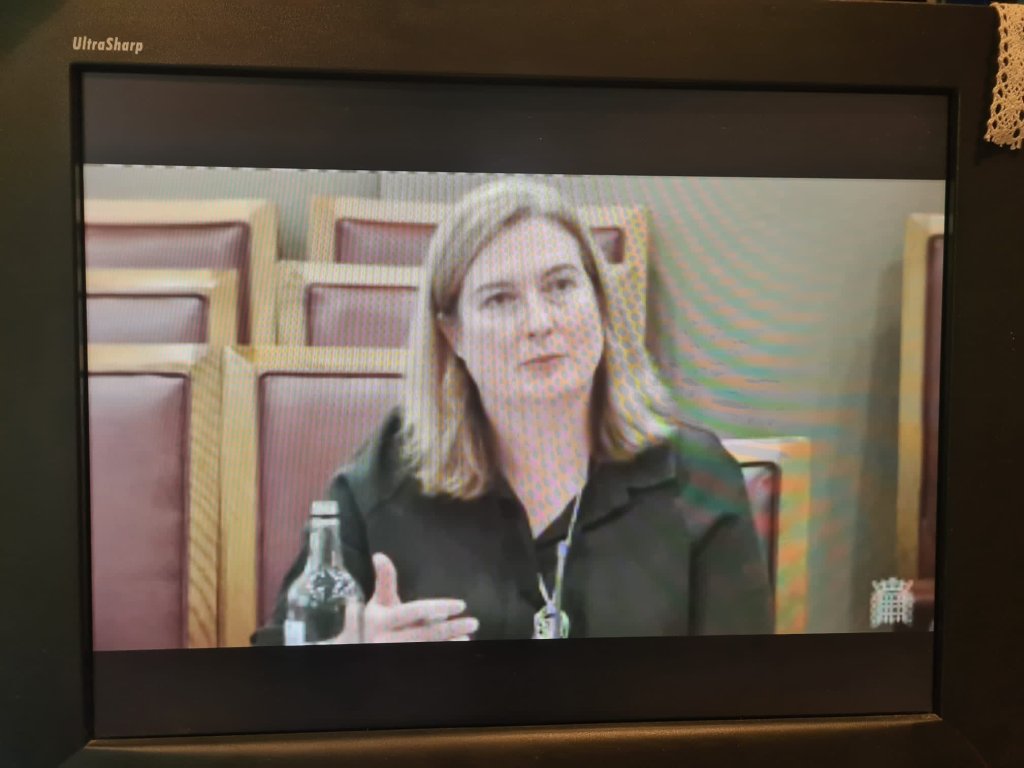
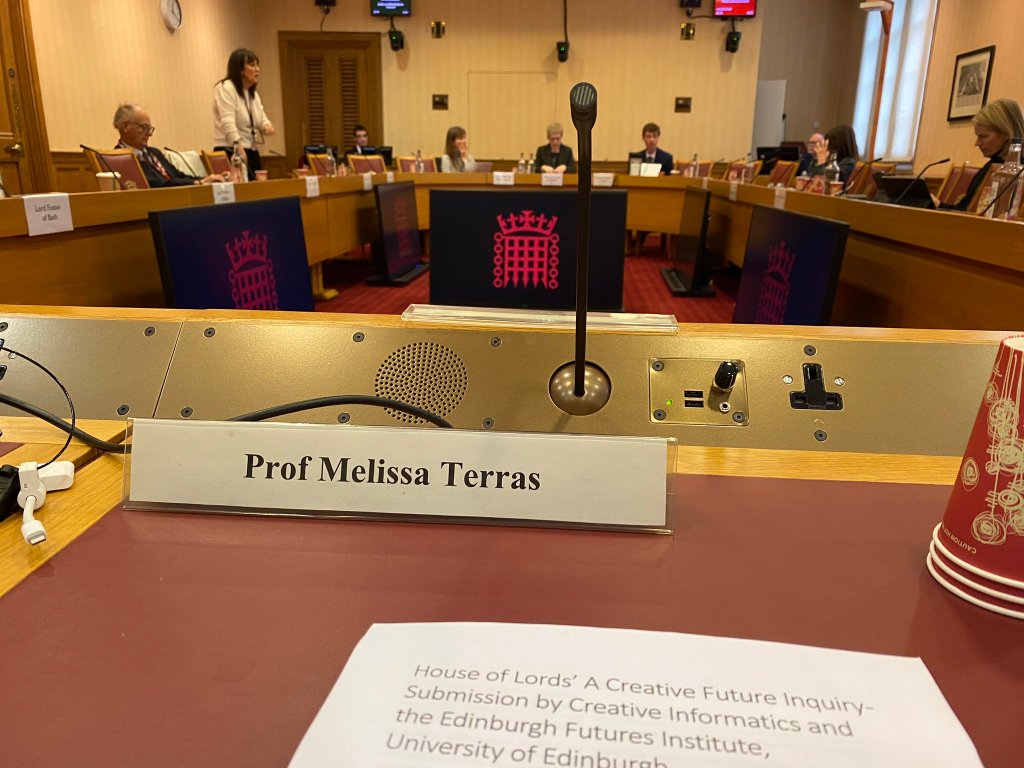
On 13th October 2022 I gave evidence in person at the House of Lords, to the Communication and Digital Select Committee’s Creative Future Inquiry. It was nerve wracking, but I was prepared, thanks to excellent briefing materials, and our previous written submission, from team Creative Informatics. The transcript is available, and you can even watch it again: here’s a picture of me on that there Parliament TV.

The full report from the committee, At risk: Our Creative Future, dropped in January 2023. It stressed that, although

the UK has long been seen as a global leader in the creative sector, rapid technological advances are changing the nature of the creative industries, and international competition is rising… Unless the Government starts taking the sector more seriously, the fundamentals that underpin our success will deteriorate and our competitiveness will decline.

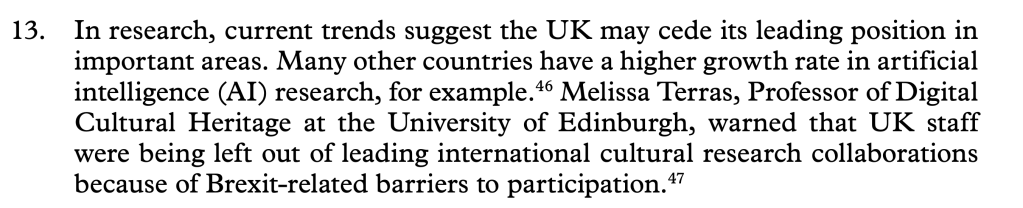
I’m really pleased that our evidence shines through the resulting report and recommendations. Something I said was even quoted in the body of the report, page 11:

Now let’s see if the government and funding agencies listen…

Millicent Garrett Fawcett: Selected Writings

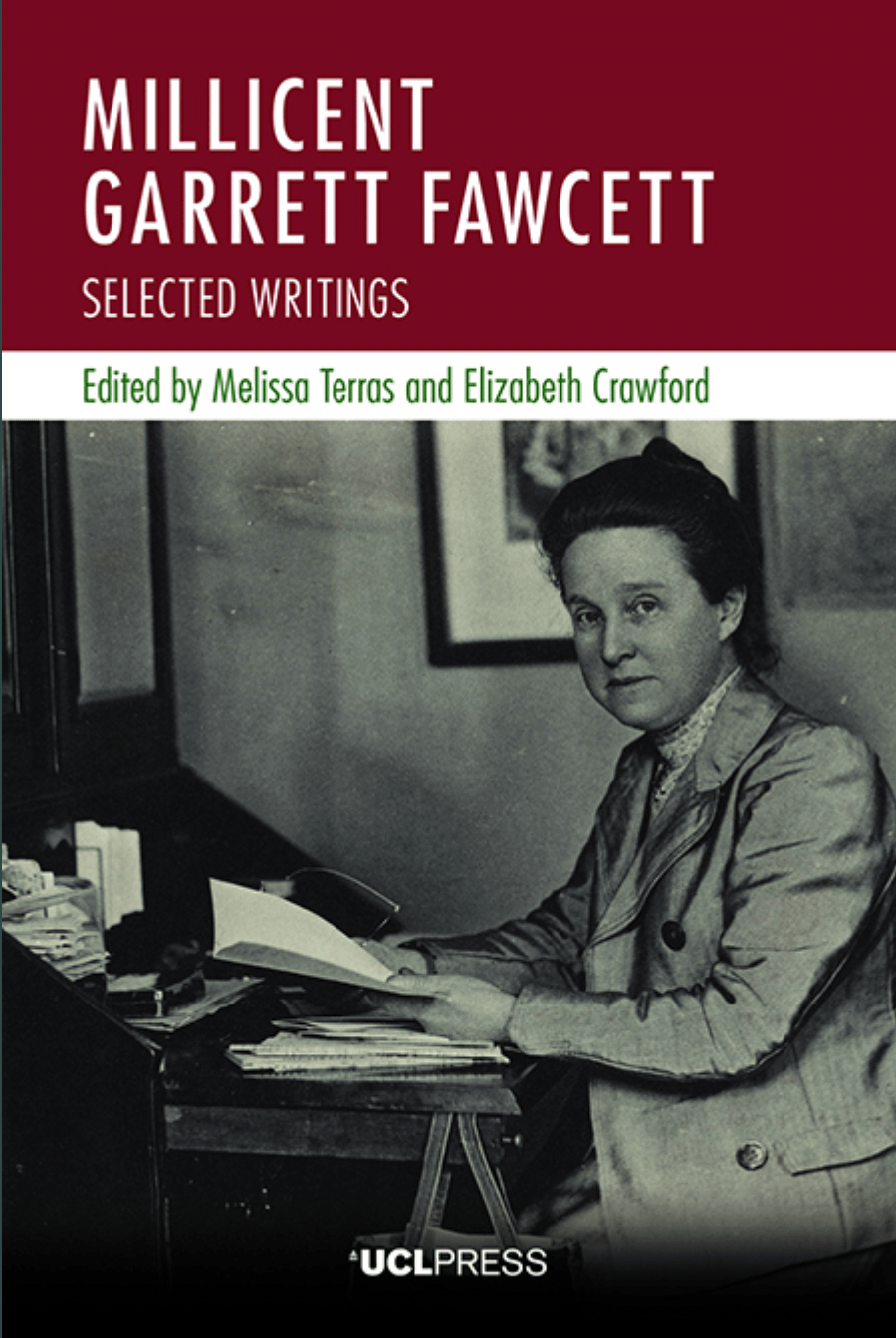
I’m very pleased to have published, with the leading Suffrage historian Elizabeth Crawford, Millicent Garrett Fawcett: Selected Writings – available open access from UCL Press a new collection of writings by this leading UK suffragist and campaigner. 

How does this relate to my own interests and trajectory? A blog post in the LSE Review of Books covers this:

Fawcett was one of the most famous women campaigners in the UK, but by the early 21st century, her achievements were, if not forgotten, then not entirely understood. The last scholarly book to be written about Fawcett was published in 1991, and no collection of her germinal speeches, pamphlets and newspaper columns has been attempted – until now.

There are various reasons for this. The UK copyright for published works authored by Fawcett expired in 1999, 70 years after her death, and so it would have only been legally possible to create a compilation of her writings – scattered across various international publications – relatively recently. However, there were also the issues of complexity and range, and of accessing often ephemeral sources… Only an ambitious (yet unfunded) plan to hunt within mass-digitised content and to undertake digitisation-on-demand for sources which were not yet digitally available allowed us to locate and synthesise all of Fawcett’s writings that we could, including discovering a good few that had never been noted before in her bibliography…

The work that went into this book – including its scale and close attention to detail – would not have been possible without the digitised information environment as well as access to both commercial and openly licensed digital cultural heritage. The timing of the compilation of this collection, too, was coincidental in only having access to digital resources: although we had luckily collected Fawcett’s writings before the COVID-19 pandemic, the write up and analysis happened at a time of social distancing, when physical access to most libraries and archives was impossible.

Millicent Garrett Fawcett: Selected Writings is therefore an example of how digital cultural heritage can be used to enhance the understanding of individuals who have not previously been centred in modern academic inquiry. Feminist digitisation practices in libraries and archives – those which centre women’s lives and their histories, taking ownership of information that has not been covered by institutionally supported digitisation or funded initiatives – can be a way to resurface feminist voices, biographies and contributions to society. The combination of using digitisation to find, source and gather material, and using mass-digitised content to understand and interrogate it, allows new, broader histories to be compiled. The digital information environment also allows these histories to be shared: we are pleased that Millicent Garrett Fawcett is available for free download via open access from UCL Press. Millicent Garrett Fawcett’s words changed a society: digital means were able to gather, understand and share them, so that her words can be read again, and understood, freely, by all.

New Chapter – Recorded performance as digital content: Perspectives from Fringe 2020

One of our major partners in Creative Informatics are the various Edinburgh Festivals, including the Fringe. We’ve worked closely with them over the pandemic, charting the sudden switch to digital, and what happened (for example see our report Learning from the 2020 Edinburgh Festival Fringe: Recommendations for Festivals and Performing Arts in Navigating Covid-19 and New Digital Contexts). I’m pleased to say that we have a new book chapter out – Recorded performance as digital content: Perspectives from Fringe 2020, which is in the new Routledge book Performance in a Pandemic, Edited by Laura Bissell and Lucy Weir. Here’s the abstract:

“Within days of performance venues being forced to close their doors in 2020, the National Theatre began broadcasting high-quality recordings of the best of London’s West End. Few other companies could dream of having such rich recorded archives to draw upon. Indeed, for many artists there is a clear tension in the very idea of recording work that is intended to be experienced live.

This essay reports on 20 in-depth interviews with performers and theatre-makers who had planned to bring shows to the 2020 Edinburgh Fringe Festival. This article reports on how performers responded to the prolonged closure of venues, and developed a series of strategies to generate value from recordings, even with limited production budgets. Crucially, very few opted to record whole live shows in empty theatres – instead they found specific uses and rationales for recording performance, while developing new expertise with sharing recorded media on digital platforms.

We argue that these digitally mediated performances are distinct from other forms of film or ‘live-to-digital’ theatre. Indeed, we suggest that this emerging genre of record will persist beyond the COVID-19 pandemic, and points to new opportunities in recording, broadcasting, and archiving performing arts as digital content.”

Citation for published version:
Elsden, C, Yu, D, Piccio, B, Helgason, I & Terras, M 2021, Recorded performance as digital content: Perspectives from Fringe 2020. in L Bissell & L Weir (eds), Performance in a Pandemic . 1 edn, Routledge, London. https://doi.org/10.4324/9781003165644

And here’s the author’s submitted copy of Recorded performance as digital content:
Perspectives from Fringe 2020
.

On Radio 3’s Between The Ears

I was delighted to be invited to contribute to a BBC Radio 3 programme, Between the Ears, with an episode called “The Virtual Symphony“, celebrating 30 years of the Internet, and the impact of it on our lives. I was interviewed for over an hour by the producer, Laurence Grissell, reflecting on my use of the internet and how it has impacted my professional and personal life, my memories of the early days in the physics and computer labs going online, and my thoughts on how it is changing society. Kieran Brunt, the composer, weaved four such interviews in with archive material, and new musical pieces, to produce a documentary that is also an artwork, showing how our relationship to and with the net is changing.

The Between the Ears logo, from BBC Radio 3.

First broadcast on Radio 3 on 18th July 2021 at 19.45, you can listen to it online, or here’s the MP3:

The official blurb goes like this! It would be great to hear what you think of it:

The joys and horrors of the internet, evoked by stories, sounds and an exciting new electronic and vocal work composed by Kieran Brunt. Opens with an introduction by the composer.

30 years ago, Tim Berners-Lee created the very first website. This powerful edition of Between the Ears explores how the internet has dramatically reshaped our lives over the following three decades.

In 1990s Glasgow, a young woman in a physics computer lab glimpses a different future for the world – and herself. In Luton, the web awakens a young man’s Sikh identity – a few years on, it will bring him riches. In 2001, a young mother in France finds escape through Wikipedia. Ten years later, an Austrian law student is horrified when he requests his personal data from Facebook…

Over four movements of music and personal stories, the Virtual Symphony moves from sunny optimism to deep disquiet, as our relationship to the internet shifts. Around these stories, composer Kieran Brunt weaves electronic and vocal elements in an exhilarating new musical work commissioned by BBC Radio 3.

Kieran Brunt and documentary producer Laurence Grissell worked in close collaboration to produce a unique evocation of the way in which the internet has fundamentally changed how we experience and understand the world.

Composer: Kieran Brunt

Producer: Laurence Grissell

Interviewees:

Melissa Terras, Harjit Lakhan, Florence Devouard and Max Schrems

Electronics performed by Kieran Brunt

Vocals performed by Kieran Brunt, Lucy Cronin, Kate Huggett, Oliver Martin-Smith and Augustus Perkins Ray of the vocal ensemble Shards

Programme mixed by: Donald MacDonald

Additional music production: Paul Corley

Additional engineering: Ben Andrewes

New Paper: Identifying the future direction of legal deposit in the United Kingdom: the Digital Library Futures approach

I’m delighted that a paper from the Digital Library Futures project has come out in the Journal of Documentation:

Gooding, P. , Terras, M. and Berube, L. (2021) Identifying the future direction of legal deposit in the United Kingdom: the Digital Library Futures approach. Journal of Documentation, (doi: 10.1108/JD-09-2020-0159)

Until this paper, there had been next to no research into how users are approaching and utilising the digital library collections now being amassed by our Legal Deposit (or colloquially known as “copyright libraries”) following the Legal Deposit Libraries (Non-Print Works) Regulations 2013, which enables and mandates them to collect digital copies of publications, as well as or instead of print. This paper addresses that gap by presenting key findings from the AHRC-funded Digital Library Futures project. Its purpose is to present a “user-centric” perspective on the potential future impact of the digital collections that are being created under electronic legal deposit regulations. Through our user study, we show that contemporary tensions between user behaviour and access protocols risk limiting the instrumental value of these digital library collections, which – although they have high perceived legacy value – are not being used in the way that they could, due to access and legal restrictions.

I’ve stuck the authors’ last copy up here, so you can read it if you can’t get beyond the paywall:

Gooding, P. , Terras, M. and Berube, L. (2021) Identifying the future direction of legal deposit in the United Kingdom: the Digital Library Futures approach (authors’ last copy, PDF).

Fully funded AHRC SGSAH CDA Studentship: “Slavery and Race in the Encyclopaedia Britannica (1768-1860): A Text Mining Approach”

I’m delighted to say I’ve been awarded a fully funded PhD studentship (open to international applicants!) with the National Library of Scotland, as a AHRC-funded Collaborative Doctoral Award, working with Professor Diana Paton (William Robertson Professor of History, University of Edinburgh), Dr Sarah Ames (Digital Scholarship Librarian, National Library of Scotland) and Robert Betteridge (Rare Books Curator (Eighteenth-Century Printed Collections), National Library of Scotland). Please do share this opportunity with recommended potential students, in History, Digital History, and/or Digital Humanities. An official advert will appear soon on UoE digital real estate, but I’m posting here first for expediency!

Fully funded AHRC SGSAH CDA Studentship: “Slavery and Race in the Encyclopaedia Britannica (1768-1860): A Text Mining Approach”

Application deadline – 5pm on Monday 17th May

Award – Annual stipend of £15,690 per year and tuition fees for 3.5 years (FTE). Open to Home and International students. (The successful candidate should reside within reasonable distance to the University of Edinburgh during the course of their studies).
PhD – English Literature

The University of Edinburgh and the National Library of Scotland are seeking a doctoral student for an AHRC-funded Collaborative Doctoral Award, “Slavery and Race in the Encyclopaedia Britannica (1768-1860): A Text Mining Approach”. The project has been awarded funding by the Scottish Graduate School for Arts and Humanities (SGSAH) and will be supervised by Professor Melissa Terras (College of Arts, Humanities and Social Sciences, University of Edinburgh), Professor Diana Paton (William Robertson Professor of History, University of Edinburgh), Dr Sarah Ames (Digital Scholarship Librarian, National Library of Scotland) and Robert Betteridge (Rare Books Curator (Eighteenth-Century Printed Collections), National Library of Scotland).

The studentship will commence on 13th September 2021. We warmly encourage applications from candidates who have a grounding in EITHER text and data mining/Digital Humanities, with proven knowledge and understanding of the history of slavery and/or race, OR UG/PG study of the history of slavery and/or race while demonstrating good technical skills and an interest in Digital Humanities/ Digital History methods. This is an extraordinary opportunity for a strong PhD student to explore their own research interests, while working closely with a major cultural heritage organisation, in important issues regarding the legacy of slavery in our information environment. 

The student will be based in the School of Literature, Languages and Cultures, at the George Square campus of the University of Edinburgh, but will also spend considerable time in the School of History, Classics and Archaeology at the University of Edinburgh, and at the National Library of Scotland. There will be a period of funded work placement at the National Library of Scotland, which will be co-determined with the student: for example, highlighting authors of articles relating to slavery and race in the Encyclopaedia Britannica, and exploring how these link to Library Collections in innovative ways.

The award will include a number of training opportunities offered by SGSAH, including their Core Leadership Programme and additional funding to cover travel between partner organisations and related events. This studentship will also benefit from training, support, and networking via the School of History, Classics and Archaeology the Edinburgh Centre for Data, Culture and Society, and the Edinburgh Futures Institute. The student will be invited to join National Library PhD cohort activities.

Project Details

“Slavery and Race in the Encyclopaedia Britannica (1768-1860): A Text Mining Approach”

How is the impact and outcomes of Atlantic slavery represented or alluded to in historical information sources? What is the legacy of slavery in our printed information environment? What text-mining approaches can be used to identify, analyse, and visualise these diverse and problematic histories? This research will use advanced digital approaches to understand how race and slavery feature in the Encyclopaedia Britannica (EB). The first eight editions of the EB, published 1768-1860, from the height of the UK’s involvement in the transatlantic slave trade, to the abolition of British slavery in 1838, and to ongoing subsequent debates about slavery and race, contains rich content related to Atlantic slavery and to forms of racialisation that developed from it. Utilising data from the newly digitised 143 volumes of the EB from the National Library of Scotland’s Data Foundry (comprising 167m words), this research will both provide insight into the explicit and implicit representation of slavery, the slave trade and race in this key reference material, but also develop a best-practice methodology for others wishing to use text mining to analyse race and slavery within other historical information sources.

This CDA will involve learning (well established) text and data mining approaches, applying them to the EB, involving unique corpus analysis that would need to consider the intellectual and cultural context in which eighteenth and nineteenth-century encyclopaedias were produced and published, and also linking and cross-referencing to other information sources available within the National Library of Scotland collection. By searching, analysing, and visualising the ways in which terms related to slavery appear in this essential reference material, using a variety of methods including GIS, accurate geoparsing, and following concepts and their relationships diachronically, we will both understand more about how Atlantic slavery was understood or instantiated within our information sources, whilst also developing a methodology for research into other similar primary reference material, and the ideas that they disseminated.

This is a timely topic, of significant relevance, given increasing interest in decolonising academic and cultural institutions. This project will have scholarly impact in Digital Humanities, History, and Library and Information Science, as we consider how to analyse, deconstruct and decolonialise historical information sources using computational methods, as well as contributing to discussions and policies at the National Library of Scotland on this topic.  

Eligibility

At the University of Edinburgh, to study at postgraduate level you must normally hold a degree in an appropriate subject, with an excellent or very good classification (equivalent to first or upper second class honours in the UK), plus meet the entry requirements for the specific degree programme.

In this case, applicants should offer a UK masters, or its international equivalent, with a mark of at least 65% in your dissertation of at least 10,000 words.

The AHRC also expects that applicants to PhD programmes will hold, or be studying towards, a Masters qualification in a relevant discipline; or have relevant professional experience to provide evidence of your ability to undertake independent research. Please ensure you provide details of your academic and professional experience in your application letter.

Experience in the study of the history of slavery and/or race, prior experience of digital tools and methods, an understanding of digitisation and the digitised cultural heritage environment, and use of quantitative research methods including text and data mining of historical sources, will be of benefit to the project.

The AHRC requires that students reside within a reasonable distance to their HEI as a condition of funding, although Covid disruption could be taken into account in the short term. 

Application Process

The application will consist of a single Word file or PDF which includes:

– a brief cover note that includes your full contact details together with the names and contact details of two referees (1 page).

– a letter explaining your interest in the studentship and outlining your qualifications for it, as well as an indication of the specific areas of the project you would like to develop (2 pages).

– a curriculum vitae (2 pages).

– a sample of your writing – this might be an academic essay or another example of your writing style and ability.

Applications should be emailed to pgawards@ed.ac.uk no later than 5pm on Monday 17th May. Applicants will be notified if they are being invited to interview by Tuesday 25th May. Interviews will take place week commencing Monday 31st May via an online video meeting platform.

Queries

If you have any queries about the application process, please contact: pgawards@ed.ac.uk

Informal enquiries relating to the Collaborative Doctoral Award project can be made to Professor Melissa Terras, m.terras@ed.ac.uk and Professor Diana Paton, Diana.Paton@ed.ac.uk

Further Information
How is the impact and outcomes of Atlantic slavery represented or alluded to in historical information sources? What is the legacy of slavery in our printed information environment? What text-mining approaches can be used to identify, analyse, and visualise these diverse and problematic histories? This research will use advanced digital approaches to understand how race and slavery feature in the Encyclopaedia Britannica (EB). The first eight editions of the EB, published 1768-1860, from the height of the UK’s involvement in the transatlantic slave trade, to the abolition of British slavery in 1838, and to ongoing subsequent debates about slavery and race, contains rich content related to Atlantic slavery and to forms of racialisation that developed from it. Utilising data from the newly digitised 143 volumes of the EB from the National Library of Scotland’s Data Foundry, this research will both provide insight into the explicit and implicit representation of slavery, the slave trade and race in this key reference material, but also develop a best-practice methodology for others wishing to use text mining to analyse race and slavery within other historical information sources.

The early EB was produced and published amidst the development of colonisation, globalisation and the transatlantic slave trade, and from its first edition it contained entries on slavery. Although the EB’s early success was facilitated by London book trading networks, it had distinctively Scottish roots, appealing to national sentiment.  In this context, examination of the early EB offers the possibility of discerning contemporary Scottish attitudes to slavery. The EB’s eventual popularity provides a useful case study concerning the representation and dissemination of ideas about slavery (and its abolition), but also the implicit legacies of the slave trade, such as the transmission of knowledge, culture, and products, as well as people. 

There is to date, a dearth of scholarship on the representation of chattel slavery in encyclopaedias. The limited studies that do exist amount to pieces of contextual evidence or small case studies that serve larger arguments. Much of the scholarship concerning the EB only examines it in terms of its publication history or epistemological approach. Studies of the early EB have omitted examination of change across particular entries across various editions. Investigation of the EB’s entry on slavery over time would in itself make a valuable historiographical addition. This doctoral project will go well beyond that, analysing the 167 million words contained in the 143 volumes of the first editions, using advanced Digital Humanities methods, particularly to look for implicit legacies of slavery, regarding products traded (eg cotton, sugar, tobacco, coffee), places mentioned (eg Haiti, Guyana, Saint Domingue, Calabar), individuals (eg Toussaint Louverture, William Wilberforce), or peoples (eg Igbo, Ashanti/Asante/Ashantee, Carib). 

Vincent Brown has argued that the nature of the slavery archive – riddled with gaps and silences – demands that historians move away from an approach that seeks straightforward ‘historical recovery’ to one that focusses on ‘rigorous and responsible creativity.’ (Vincent Brown, ‘Mapping a Slave Revolt: Visualizing Spatial History through the Archives of Slavery’, Social Text 33 (2015), p.134). There are existing, innovative digital humanities (DH) approaches to the study of slavery. Projects have used computational methods to explore large-scale corpora of slavery-related literature, examining the size of the English lexicon, the evolution of grammar and the frequency with which certain words or phrases were used over time, or in the study of emotions in narratives written by enslaved people. There is a broader range of DH projects that examine slavery in the Atlantic world, which have made novel historiographical contributions, perhaps most notably the broad databases Slave Voyages (https://www.slavevoyages.org/) and Legacies of British Slaveownership (https://www.ucl.ac.uk/lbs/), recently brought together with other projects as Enslaved (enslaved.org) but also the more focused Runaway Slaves in Britain (https://www.runaways.gla.ac.uk/) and the Early Caribbean Digital Archive (https://ecda.northeastern.edu/home/about/decolonizing-the-archive/). What we describe is the utilisation of (well established) text and data mining approaches, applied to the EB, involving unique corpus analysis that would need to consider the intellectual and cultural context in which eighteenth and nineteenth-century encyclopaedias were produced and published, and also linking and cross-referencing to other information sources available within the National Library of Scotland collection. By searching, analysing, and visualising the ways in which terms related to slavery appear in this essential reference material, using a variety of methods including GIS, accurate geoparsing, and following concepts and their relationships diachronically, we will both understand more about how Atlantic slavery was understood or instantiated within our information sources, whilst also developing a methodology for research into other similar primary reference material, and the ideas that they disseminated.

The University of Edinburgh is an ideal place to carry out this research. The Edinburgh Centre for Global History, which Paton directs, has Migration, Slavery and Diaspora studies as one of its three thematic hubs (https://www.ed.ac.uk/history-classics-archaeology/centre-global-history). The Centre for Data, Culture and Society’s recent push to establish text and data mining as a core research interest alongside training events and materials (https://www.cdcs.ed.ac.uk), aligned with support from the Edinburgh Parallel Computing Centre’s research software engineers (https://www.epcc.ed.ac.uk). We have already mounted the EB on EPCC systems, and ran preliminary searches on a selection of terms, as a pilot study to establish that there would be enough content upon which to build a PhD, in the analysis and visualisation of results. The candidate would be trained in both R and Python, and have access to our in-house text-mining at scale platform, Defoe (see “defoe: A Spark-based Toolbox for Analysing Digital Historical Textual Data”, Filgueira Vicente, R et al, 2019 https://doi.org/10.1109/eScience.2019.00033). 

This is a timely topic, of significant relevance, given the Black Lives Matter movement and increasing interest in decolonising academic and cultural institutions. The University of Edinburgh has recently established the Institute for Advanced Study in the Humanities Institute Project on Decoloniality (2021-24) (https://www.iash.ed.ac.uk/institute-project-decoloniality) and the candidate can engage with this. This project will have scholarly impact in Digital Humanities, History, and Library and Information Science, as we consider how to analyse, deconstruct and decolonialise historical information sources using computational methods.  

New article: The value of mass-digitised cultural heritage content in creative contexts

One of the projects I’m working on right now is Creative Informatics, (2018–2023), which aims to enhance data-sharing and innovation across the creative sectors throughout the City of Edinburgh and local regions, to develop ground-breaking new products, businesses and experiences, as part of the Creative Industries Clusters Programme (2020). I’m pleased to share our first team effort paper, which just came out in Big Data and Society, in its special edition on Heritage in a World of Big Data: re-thinking collecting practices, heritage values and activism, edited by Chiara Bonacchi (which is a fab set of papers, btw). Our paper is fully open access, so I’ll paste the abstract in here, and the full citation.

How can digitised assets of Galleries, Libraries, Archives and Museums be reused to unlock new value? What are the implications of viewing large-scale cultural heritage data as an economic resource, to build new products and services upon? Drawing upon valuation studies, we reflect on both the theory and practicalities of using mass-digitised heritage content as an economic driver, stressing the need to consider the complexity of commercial-based outcomes within the context of cultural and creative industries. However, we also problematise the act of considering such heritage content as a resource to be exploited for economic growth, in order to inform how we consider, develop, deliver and value mass-digitisation. Our research will be of interest to those wishing to understand a rapidly changing research and innovation landscape, those considering how to engage memory institutions in data-driven activities and those critically evaluating years of mass-digitisation across the heritage sector.

Terras, M., Coleman, S., Drost, S., Elsden, C., Helgason, I., Lechelt, S., Osborne, N., Panneels, I., Pegado, B., Schafer, B. and Smyth, M., 2021. The value of mass-digitised cultural heritage content in creative contextsBig Data & Society8(1), p.20539517211006165.

It’s worth stressing that we problematise the act of considering such heritage content as a resource to be exploited for economic growth before people set the pitchforks upon us.

It was a great paper to write with the team, and I can recommend working with the BD&S editors and peer reviewers – this one had a few turns around the block, and it is all the better for it.

#DHGoesViral, a year on

I haven’t talked much about on here about the pandemic. A year ago today, the #DHgoesViral twitter conference happened, swiftly organised by Agiati Benardou at the outbreak of Covid-19 across Europe. By then we were a few weeks into a rapid change in how we were all living, and locked down at home with minimal contact with the outside world. Only a few weeks before – and the day before the UK lockdown started – I remember talking to a senior administrator, who was convinced universities wouldn’t close. We were closed down 24 hours later. Everything was stress and uncertainty and a huge cognitive load to deal with.

DH in the time of Virus played out entirely over twitter. It saw Digital Humanities experts, both academics and practitioners, as well as Digital Research Infrastructures and Initiatives from across Europe, give their thoughts on what was happening to our field and our professional areas at the time of the sudden lockdowns. I was asked to give mine, and honestly, finding the mental ability to concentrate on preparing these 10 tweets was hard, it took me nearly a day (when in normal life I could bash this out in 10 mins or so, although what is normal anymore….?). I thought I would park them here, to think about what has changed – and what is the same – at the end of our second lockdown in the UK, and as central Europe goes into its third.

You can see the starting point for the other #DHgoesViral twitter stream “talks” on this blog. Here was mine. I can see now we’re not so panicked, but still restricted. We’re still depending on infrastructures that are under resourced. There are still loads of people doing a tonne of work behind the scenes. And we’re dependent on digital given the libraries and archives are (at the moment) still closed…

Look after yourselves, everyone.